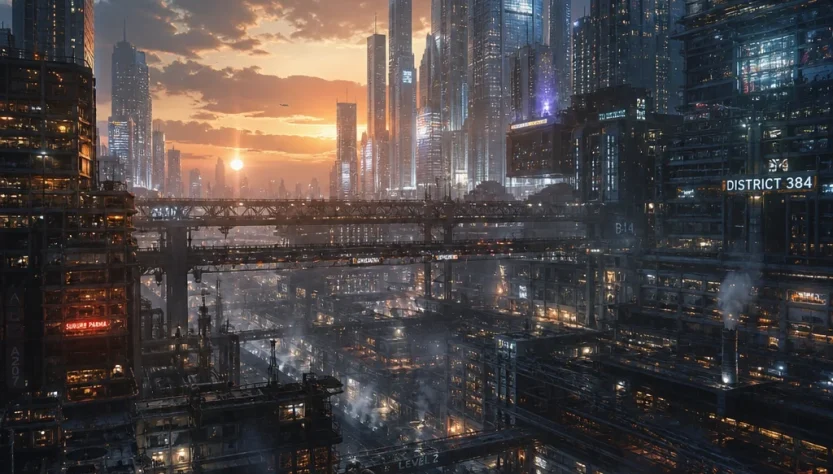
A convincing futuristic universe does not begin with a flashy spaceship or an alien landscape. It begins with a fundamental economic and sociological question that most creators skip: what does it actually cost to live here? Readers and players will forgive an implausible anti-gravity engine or faster-than-light communication long before they forgive a world that behaves like a painted theatrical backdrop. World-building is not mere decoration or aesthetic window dressing. It is the hidden, humming machinery that makes every choice a character makes feel inevitable, heavy, and real. What follows is a rigorous, practical anatomy of speculative settings, designed to take you from your first foundational rule down to the microscopic sensory details that convince an audience they have genuinely inhabited another time and space.
Start With a Constraint, Not a Backdrop
Every truly memorable speculative setting reduces down to one core sentence that alters human behavior at a systemic level. In one universe, information is completely free, but personal privacy has become the ultimate currency. In another, faster-than-light travel exists, but the sheer energy cost restricts it strictly to cargo, leaving humanity tethered to slow generational ships for migration. These premises are not mere trivia to fill an appendix; they are active atmospheric pressure systems. A useful litmus test for your setting is asking what an ordinary, working-class person fundamentally cannot do. Constraints organically generate culture, because culture is simply the cumulative set of survival habits people develop to cope with their limitations.
If your sci-fi premise removes a classic problem, you must immediately ask what new, unforeseen problem it creates. For instance, cheap, limitless fusion energy does not end human conflict; instead, it simply relocates that conflict to whoever physically controls the distribution grid. Write your core constraint down on a physical card and keep it visible while you write. When a scene stalls out, look back at that rule. It will almost always tell you what happens next because it defines who is desperate, who is comfortable, and who holds the leverage. A world where drinking water is strictly metered produces a very specific breed of antagonist: not a galaxy-conquering emperor, but a petty, calculating landlord.
Make Technology Expensive in Ways That Are Not Money
In any believable future, advanced technology is invariably rationed by something other than standard cash. It might be constrained by raw energy allocation, human attention spans, rare isotope scarcity, strict legal licensing, ritual taboos, or sheer bureaucratic friction. If a miracle device is entirely free and available to everyone, everyone uses it, and the moment everyone has it, it ceases to be a driver of dramatic tension. Instead of showing the glamorous launch day of a new tech product, show the gritty maintenance layer behind it. Show the technician who repairs the atmospheric recycling drones. Show the bureaucrat who recertifies an obsolete cybernetic airlock. Show the exhausting paperwork a family must file just to keep a life-saving medical implant running. Readers instantly trust a world where the miraculous comes with a complex, fragile supply chain.
Institutions themselves represent the second major price tag of progress. A futuristic society equipped with complete weather control will still endlessly argue over municipal zoning laws, disaster insurance premiums, and who gets the morning rain versus the afternoon sun. Technological progress does not delete bureaucracy; it merely relabels it with more impressive vocabulary. The most convincing futures are densely populated by tedious committees, endless appeals boards, and legacy computer systems that nobody fully understands anymore, because that is what genuine human administration actually looks like after a few decades of operation.
Let Geography and Infrastructure Write the Culture
Culture is largely climate and logistics wearing a cultural costume. A human settlement built vertically around a massive planetary transit shaft develops rigid class markers determined entirely by floor number. A remote colony completely dependent on imported pharmaceuticals develops strict quarantine etiquette and a deep, systemic suspicion of passing travelers. A coastal city that floods on a seasonal cycle builds its domestic architecture around high-water marks and its folklore around the last truly catastrophic storm. Before you invent an elaborate religious festival, decide precisely where the drinking water comes from and where the toxic waste goes.
Ask three mandatory questions about any location in your world: How do average people acquire their daily food? How do they commute to work? What happens to the community when the critical infrastructure fails? The raw answers to these three questions will effortlessly produce clothing styles, regional slang, architectural quirks, and political grievances without requiring any forced invention. Furthermore, infrastructure is the cheapest and most effective source of visual identity. A rusted freight elevator, a cracked utility service tunnel, or a hydroponic rooftop garden tells a reader far more about a society than an entire paragraph of dry historical exposition.
Language Is a Map of Values
Naming conventions reveal social hierarchy and historical trauma faster than any multi-page history chapter. If every citizen in a region uses three distinct names, ask who in that society is legally permitted to drop one. If children automatically inherit a parent’s exact trade as their surname, your world has already communicated what it respects and what it traps people within. Slang is an even more efficient narrative tool. A single unique word for a common fear, a recurring form of systemic humiliation, or a specific type of machinery breakdown implies that the experience is frequent enough to require its own linguistic shorthand.
Borrow linguistic elements sparingly and consistently. Invented futuristic words work best when they follow the phonetic rules of the surrounding language and when readers can easily deduce their meaning from contextual clues. Random apostrophes and chaotic capital letters are not sophisticated world-building; they are a tax on the reader’s patience. Instead, give old, familiar words entirely new professional jobs. A linguistic shift where a single term means both a standard work shift and a neurological data transfer is infinitely more unsettling than a made-up glossary term, because it implies a culture that has completely stopped distinguishing between human labor and data storage.
Power Needs a Receipt
Every political faction, criminal syndicate, and corporate entity in your universe must be able to answer one fundamental question: who pays for this apparatus, and who directly benefits from it? Empires, merchant guilds, worker cooperatives, and corporate boards all require a viable revenue model and a founding grievance. If your central government possesses the technology to control planetary gravity, it inherently controls building construction, which means it controls housing, which ultimately means it controls who gets to have children and families. Follow the power chain all the way down until it reaches a kitchen table. That is the exact point where abstract politics transforms into a compelling story.
You must also decide what absolute power cannot do. A sprawling surveillance state that still manages to regularly lose dissidents in the shadows is far more frightening than one that is omniscient and infallible, because it admits that the machinery is still run by flawed human beings. Institutional weakness, corruption, and blind spots are never plot holes—they are structural doorways designed for your characters to walk through.
Design the Economy Before the Skyline
Ask what the average working household earns, what they pay in rent, and what debts they carry. Currencies, credit systems, and systemic debt shape human psychology and behavior far more reliably than high-minded political ideology. A world featuring universal basic income generates a completely different artistic and cultural output than a world driven by indentured labor contracts, even if both societies boast sleek flying cars. Decide what commodities are scarce, what is heavily subsidized, and what is quietly stolen by the state. Then, show a character checking their digital account balance. Nothing grounds a speculative setting faster than an ordinary person doing basic arithmetic over an expensive utility bill.
You must also decide who performs the unpleasant, unglamorous labor. Every future has sanitation crises, structural maintenance, and caregiving labor. If your fictional setting never showcases these workers, the reader will rightly assume they are performed by an underclass that the narrative has chosen to ignore—which is a profound political statement, whether you intended it to be one or not.
Small Details Do the Heavy Lifting
Readers ultimately believe in a fictional world through its mundane, everyday objects. What do ordinary people eat when they are depressed or grieving? What constitutes an acceptable cheap gift? What does a standard funeral look like, and who is legally allowed to speak at it? What is the most common, annoying advertisement plastered across public transit? Answer four or five of these mundane questions early in your process, then repeat the answers naturally until they feel like familiar furniture. Consistency in small, throwaway things buys you enormous narrative credibility when you introduce large, impossible concepts.
Make the Senses Specific
Two or three recurring sensory anchors will make your fictional world feel physically present. The distinct smell of heavily recycled indoor air. The low-frequency hum of a district power grid at midnight. The rough, synthetic texture of a fabric that everyone owns but secretly despises. Use these sensory details sparingly yet consistently, so that a single mention later in the narrative can instantly trigger the entire atmosphere in the reader’s mind. Atmosphere is not the same thing as a long descriptive paragraph; atmosphere is deliberate repetition mixed with subtle variation.
Give the World a Past It Would Rather Forget
A speculative setting without a troubled history feels newly constructed, and newly constructed places always read like cheap movie sets. Give your universe at least one massive historical event that every character references, but that no two people explain the exact same way. A resource war, a catastrophic migration, a sudden planetary blackout, or a peace treaty signed under extreme duress. Public monuments, school curricula, and awkward silences at family dinner tables should all hang from that single historical event. Let different factions and characters carry competing versions of it. History in fiction is most powerful and useful when it remains fiercely contested.
Build a Bible, Then Break It on Purpose
Maintain a working reference document containing names, dates, interplanetary distances, market prices, and core physical rules. Consistency is not an innate artistic talent; it is basic logistical discipline. Actively track the elements that astute readers track: travel times, physical injuries, currency values, and who possesses critical knowledge. When you deliberately choose to contradict your own internal notes, do so only because that contradiction serves a dramatic purpose and you have already prepared a narrative explanation for it.
Common Failure Modes to Avoid
- Decoration without function: The futuristic setting is elaborately described but never actually forces a character to make a difficult decision.
- Monoculture: A single sprawling city stands in for an entire planet, and every inhabitant shares the exact same worldview and values.
- Frictionless technology: High-tech devices effortlessly solve dramatic plot problems before the characters have earned the resolution.
- Glossary dumping: The opening chapter reads like a technical repair manual with dialogue awkwardly attached to it.
- Borrowed aesthetics: The visual look is striking and familiar, but the underlying economics that support it are entirely missing.
- Inflation of scale: Vast galaxies are described with the emotional flatness and scale of a mundane suburban neighborhood.
The Grocery List Test
Here is your final, definitive check for setting believability. Can you write a standard grocery list in this universe and have it sound like somebody’s actual, exhausting week? Not a heroic, action-packed shopping trip, but a tired one. What food is currently out of season, what is suspiciously cheap due to government subsidies, what requires a special purchase permit, what a tired child begs for in the aisle, and what the exhausted shopkeeper has to apologize for. If you can successfully produce that list, your speculative setting has a living, breathing pulse. If you cannot, you simply have a mood board. Convincing futures are not defined by having the most inventions; they are defined by the consequences those inventions inflict upon the kitchen table, the medical clinic, and the daily commute.
“